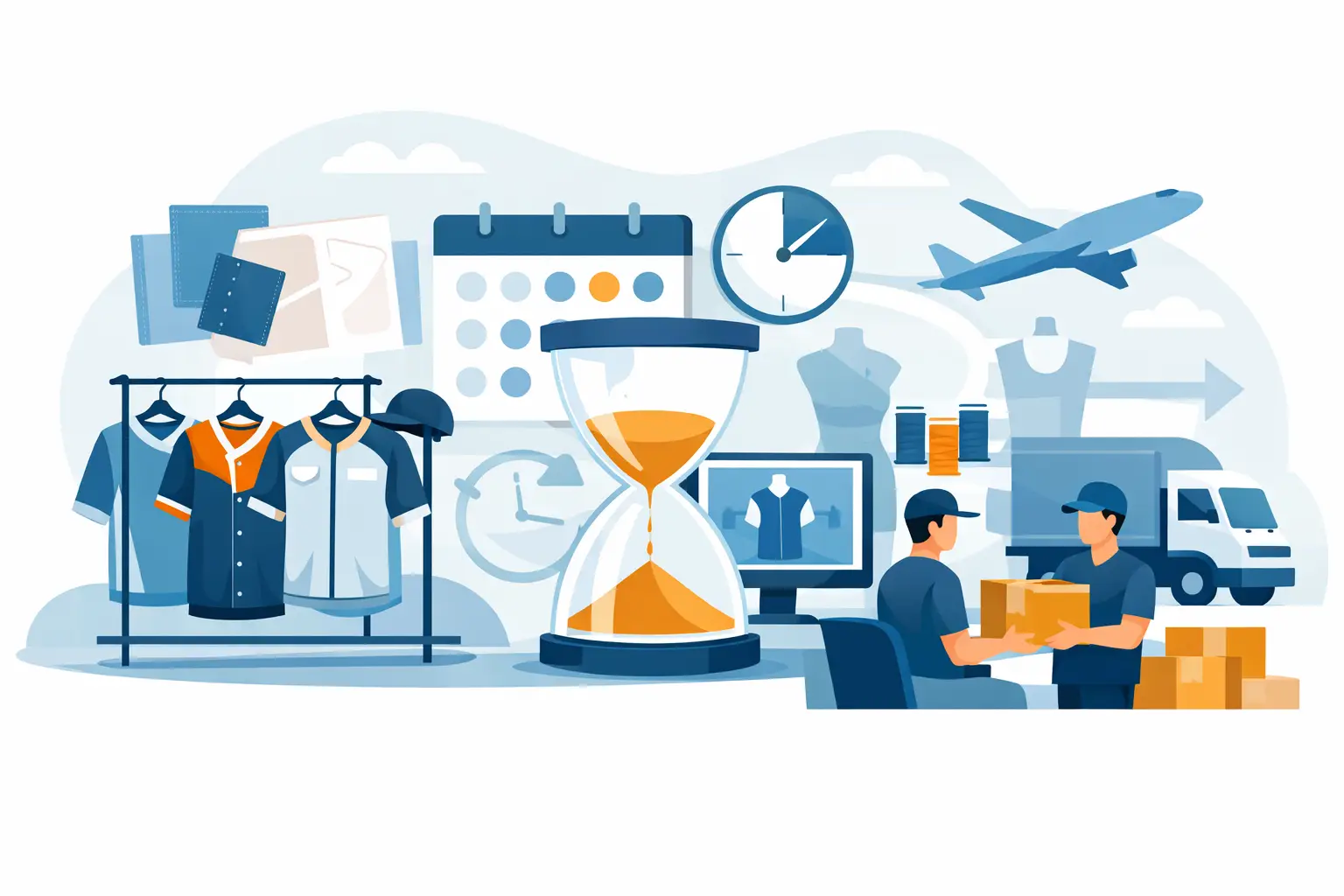
If you are asking how long do custom uniforms take, you are probably already working backward from a deadline – a staff rollout, school opening, product launch, trade show, or team event. That is exactly the right way to think about it. Uniform production is not just about printing a logo on a shirt. It is a coordinated process that moves from concept and approvals to sourcing, decoration, quality control, and delivery.
For most bulk orders, custom uniforms typically take anywhere from 2 to 8 weeks. That range is wide for a reason. A simple reorder on an existing garment with one-color printing can move quickly. A fully custom uniform program with dyed fabric, multiple sizes, embroidery, add-on trims, and mixed product categories will take longer. The real answer depends on what you are making, how customized it is, and how quickly approvals happen on your side.
How long do custom uniforms take for most orders?
A practical benchmark is 3 to 5 weeks for many standard custom uniform orders, especially when the base garments are available and the decoration method is straightforward. This timeline usually covers artwork confirmation, production scheduling, printing or embroidery, inspection, packing, and dispatch.
If your order is more specialized, the timeline can stretch to 6 to 8 weeks or longer. This is common with cut-and-sew uniforms, custom fabric colors, sublimation programs, or projects that involve several product types under one order. For example, outfitting a company with polos, jackets, caps, and tote bags under a single brand standard naturally takes more coordination than ordering one style of staff tee.
Rush jobs are possible in some cases, but speed always comes with trade-offs. You may need to simplify decoration, choose ready-stock garments, reduce customization, or lock approvals faster. If your delivery date is fixed, the best production partner will tell you early what is realistic and what needs to change to protect the timeline.
The stages that determine delivery time
Uniform lead time is built in phases, and delays usually happen between phases rather than during actual production. Understanding the flow helps you plan better and avoid last-minute pressure.
1. Briefing and quotation
This stage can take a day or several days depending on how clear your requirements are. If you already know garment type, quantity, size breakdown, logo placements, decoration method, and delivery date, quoting moves faster. If you are still comparing fabrics, colors, and branding options, this stage naturally takes longer.
For procurement teams and event organizers, this is where internal alignment matters. A fast supplier response cannot offset slow internal decision-making.
2. Design and approval
Once the concept is defined, artwork mockups, size specs, garment details, and branding placement need approval. This can be quick on a repeat order and much slower on a first-time program.
This is one of the biggest timing variables. A production line cannot move confidently until the specifications are locked. Every revision to logo size, thread color, panel layout, or garment shade can shift the schedule. If multiple stakeholders need to sign off, build extra time into the plan.
3. Sourcing materials or selecting ready stock
If the uniforms are based on in-stock blanks, this step is usually shorter. If the garments are fully custom-made, production may require fabric booking, dyeing, trims, labels, accessories, or size set confirmation before manufacturing starts.
This is also where quantity matters. A 50-piece order and a 5,000-piece order do not move through the same sourcing logic. Larger runs often benefit from production efficiency, but they may also require more material planning upfront.
4. Production and decoration
This is the phase most buyers think of first, but it is only one part of the timeline. Production time depends heavily on the decoration method and garment construction.
Screen printing is efficient for volume once setup is complete. Embroidery usually takes longer because stitch count, placement, and machine time all affect output. Sublimation is ideal for all-over graphics and teamwear, but it works within its own production sequence. Heat transfer and direct-to-garment can be fast for certain applications, though they are not always the right fit for every uniform program.
If your order includes different methods across multiple products, the schedule needs to account for each one.
5. Quality control, packing, and shipping
Reliable suppliers do not skip inspection just to move faster. Bulk uniform orders need checking for sizing consistency, decoration placement, color accuracy, finishing, and count. Then items need to be sorted, packed, labeled if required, and prepared for delivery.
Shipping time is separate from production time. That distinction matters. A project might be produced on schedule and still arrive late if transport planning was left too tight.
What makes custom uniforms take longer?
The short answer is customization depth. The more unique your order, the more steps are involved.
A standard polo with left-chest embroidery is relatively simple. A custom corporate uniform with matched brand colors, woven labels, contrast piping, individual name personalization, and multiple departments needing different garment types is more complex. None of that is a problem, but it does require more lead time.
Order size can also affect timing in two directions. Very small orders may be limited by setup efficiency or minimum production thresholds. Very large orders may need phased manufacturing, especially during peak periods.
Seasonality matters too. Back-to-school cycles, year-end campaigns, sports seasons, and large event windows often increase demand. If you order during a peak period, expect tighter production capacity and less room for last-minute changes.
Then there is approval speed. In many projects, the biggest delay is not manufacturing – it is waiting for artwork confirmation, PO release, final size breakdown, or management sign-off. Buyers who prepare these items early usually get better timeline control.
How to shorten the timeline without risking quality
If delivery speed matters, there are practical ways to compress the schedule.
First, finalize your requirements before requesting production. Be clear on quantities, sizes, branding locations, garment types, and delivery deadline. A strong brief reduces back-and-forth and lets the supplier plan accurately.
Second, choose ready-stock garments when time is tight. Custom-made uniforms offer more control over design and identity, but stocked styles can cut weeks from the process.
Third, simplify where it makes sense. One decoration method is faster to manage than several. Standard colors are easier than custom dyeing. Fewer revisions mean faster approvals.
Fourth, submit usable artwork files from the start. Poor files create unnecessary proofing rounds and can delay decoration setup.
Finally, work with a supplier that manages the process end to end. When design support, garment sourcing, decoration, quality checks, and delivery coordination sit under one operational roof, there are fewer handoff points and fewer chances for misalignment. That is especially valuable for organizations ordering uniforms alongside promotional products or event merchandise.
How long do custom uniforms take when you need full customization?
Fully custom uniforms usually take longer because they are built from specification, not just decorated after the fact. If you want custom fabric, exact Pantone matching, non-standard trims, personalized labeling, or pattern-based construction, expect a more extended timeline than a basic print job.
That extra time often pays off. For businesses managing brand identity across multiple locations or teams, full customization creates stronger consistency and a more professional result. The key is planning early enough to give production the time it needs.
For these projects, 6 to 8 weeks is a safer expectation, and some programs may need more depending on complexity and order volume. If your launch date is fixed, begin the conversation as early as possible.
A realistic planning rule for businesses and teams
If you need uniforms for a specific date, do not plan around the fastest possible timeline. Plan around the safest realistic one.
For simple bulk orders, give yourself at least 3 to 4 weeks. For more customized programs, allow 6 to 8 weeks. If the order involves multiple products, branded accessories, or separate departments, add buffer time. The cost of planning early is low. The cost of scrambling before an opening, event, or rollout is much higher.
This is where an experienced production partner makes a measurable difference. A supplier should not just take an order. They should help you pressure-test the schedule, identify risks early, recommend the right decoration method, and keep the project moving against your deadline. That is how teams protect both brand standards and delivery dates.
At Green Cotton, that planning mindset is part of the job. When uniforms are tied to brand presentation, staff readiness, or event execution, timing is not a side issue – it is part of the product.
The smartest move is simple: start earlier than you think you need to, approve faster than you think you should, and choose a production partner that treats your deadline like a commitment, not a guess.