When your team is customer-facing, on-site, or moving across multiple departments, uniforms do more than identify staff. They signal standards. A custom workwear embroidery service gives that uniform a permanent, polished finish that printed logos often cannot match, especially when garments need to hold up through repeated wear, washing, and demanding job conditions.
For procurement teams, HR managers, operations leaders, and event coordinators, embroidery is rarely just a design choice. It is a decision about durability, brand consistency, and how well a supplier can manage production at scale. The right result depends on more than putting a logo on a shirt. It depends on garment selection, stitch suitability, logo setup, placement accuracy, and production control from sample to bulk delivery.
What a custom workwear embroidery service should actually deliver
A reliable custom workwear embroidery service is not only about decorating finished garments. It should help you match the logo treatment to the purpose of the uniform. A front desk polo, a warehouse shirt, a field technician jacket, and a hospitality apron do not perform in the same way, so the embroidery approach should not be identical either.
Embroidery works best when the supplier looks at the full specification. That includes fabric type, garment weight, logo size, stitch density, thread color matching, placement, and expected wash frequency. If any one of those details is treated casually, the final result may look acceptable in a sample but inconsistent across a bulk order.
For business buyers, this is where experience matters. A capable production partner will flag issues early, such as logos that are too detailed for small chest placement, lightweight fabrics that may pucker under dense stitching, or contrasting thread colors that need better visibility on darker garments. Those adjustments save time and protect brand presentation before production begins.
Why embroidery remains a strong choice for workwear
Embroidery continues to be a preferred branding method for uniforms because it conveys permanence. On polos, button-downs, jackets, vests, caps, and heavier work shirts, embroidered logos tend to look structured and professional. That matters when employees interact directly with customers, visitors, or business partners.
There is also a practical advantage. In many work environments, uniforms are washed frequently and used hard. Embroidery generally holds its visual integrity well over time, particularly for company logos, department names, and individual personalization. It is often a better fit than print when the goal is long-term use rather than short-term campaign wear.
That said, embroidery is not the right answer for every garment or every artwork file. Large back graphics, highly detailed illustrations, and soft lightweight tees may be better suited to screen printing, heat transfer, or direct-to-garment methods. The best supplier will not force embroidery onto every order. They will recommend it where it performs best.
The garments matter as much as the stitching
One of the most common buying mistakes is choosing embroidery first and the garment second. In practice, the garment sets the foundation. Fabric composition, surface texture, thickness, and construction all affect how cleanly the embroidery will sit.
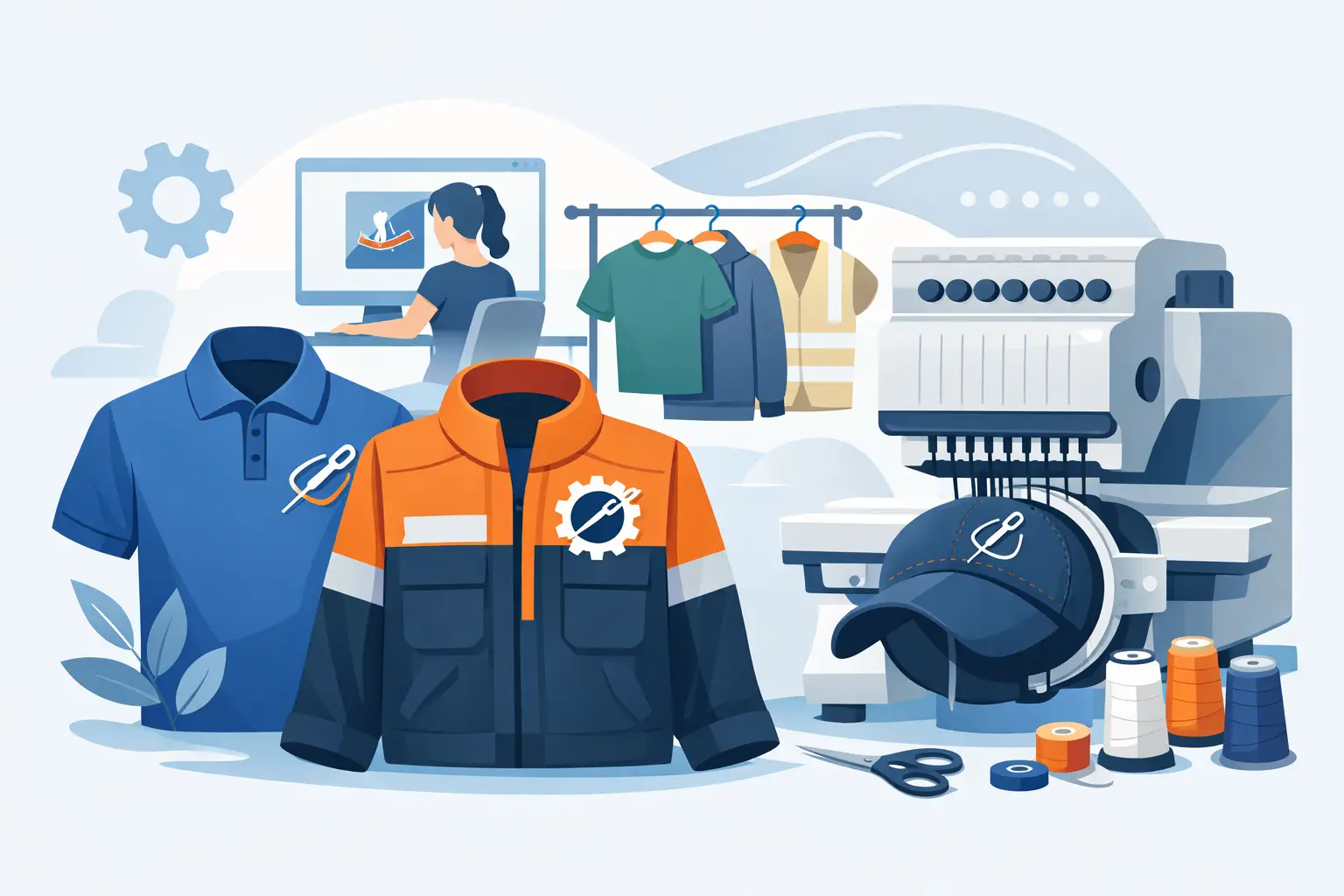
For example, pique polos and structured woven shirts usually support chest embroidery well because the fabric has enough body to stabilize the stitches. Soft performance fabrics may require more careful backing and digitizing. Heavy outerwear can carry larger embroidered marks, but seam placement and lining access become more important. Caps introduce curvature, panel structure, and height limitations that change how a logo needs to be prepared.
This is why organizations benefit from working with a supplier that offers broad garment options alongside in-house decoration. When product selection and embroidery setup are handled together, there is less guesswork. You can match the right uniform style to the right branding method instead of trying to make one stock solution fit every department.
Logo setup is where quality starts
Embroidery quality begins long before the machine runs. Your logo needs to be digitized for stitching, which means converting the artwork into a file that tells the machine how to build the design with thread. This is not a simple file conversion. It is a technical preparation process that affects sharpness, thread direction, coverage, and final readability.
A logo that looks crisp on screen may not stitch cleanly at 3 inches wide on a left chest. Small text can fill in. Fine outlines can disappear. Tight spacing can blur. Good digitizing accounts for these limitations and adapts the artwork without losing brand recognition.
This is especially important for multi-location businesses, schools, franchise groups, and large teams where consistency matters. If different batches are digitized differently or stitched on different garments without controls, the logo can shift from one order to the next. A professional embroidery service protects against that by standardizing setup and documenting approved specifications.
What business buyers should ask before placing a bulk order
The supplier should be able to explain how they handle artwork approval, thread color matching, sample verification, bulk production, and delivery timelines. If those answers are vague, the risk usually shows up later as delays, placement issues, or inconsistent finishing.
It also helps to ask how the embroidery will be positioned across sizes. Left chest placement should not feel too high on smaller sizes or too low on larger ones. The same applies to sleeve logos, back neck details, and name personalization. Good production teams plan for scaling and positioning, not just stitching one sample and repeating it blindly.
You should also confirm whether the supplier can manage mixed product categories in one project. Many organizations do not need only shirts. They may need polos for office staff, industrial workwear for operations, caps for outdoor teams, and bags for events. Coordinating that through one production partner simplifies approvals, reduces communication gaps, and improves brand consistency.
When custom workwear embroidery service adds the most value
A custom workwear embroidery service is especially valuable when your uniforms serve an ongoing operational role rather than a one-time promotional use. That includes staff uniforms, corporate apparel, hospitality wear, logistics teams, maintenance crews, school staff apparel, and branded outerwear.
It also makes sense for organizations that need a more premium appearance. Embroidery tends to elevate polos, jackets, fleece, and caps because the texture adds dimension. For customer-facing roles, that detail can support a stronger first impression without making the garment look overdesigned.
For internal teams, embroidery can also support structure. Adding employee names, department identifiers, or branch locations helps with identification and accountability. The key is to keep the layout clean. Too much information on one garment can make even high-quality embroidery look cluttered.
Balancing cost, durability, and appearance
Embroidery is often seen as the premium option, but the decision should still be practical. The best choice depends on garment type, order volume, logo complexity, and use case. A simple one-position embroidered logo on durable work shirts can deliver strong long-term value. A large, highly detailed design across multiple placements may increase cost and production time significantly.
That does not mean it should be avoided. It means the order should be planned properly. In many cases, refining logo size, reducing unnecessary detail, or selecting more embroidery-friendly garments improves both visual quality and cost efficiency.
This is where consultative support matters. A good supplier does not simply quote what was requested. They help you shape a specification that performs well in production and in actual wear. That is the difference between buying decorated apparel and building a uniform program that works.
Production control is what protects your brand
The embroidery itself may be visible, but the real value is in the process behind it. Consistent thread tension, clean trimming, correct backing, stable placement, and final quality checks are what separate dependable bulk production from avoidable rework.
For organizations ordering at scale, accountability matters just as much as decoration quality. You need a supplier that can manage deadlines, maintain specification accuracy, and produce across garment categories without letting details slip. Green Cotton approaches this as a full-service production responsibility, not a one-step add-on. That matters when your uniforms are tied to team readiness, brand image, and scheduled rollout dates.
The best results come from treating embroidery as part of a larger uniform system. When garments, branding, approvals, and production are aligned from the start, your team receives workwear that looks consistent, wears well, and arrives ready for use.
If you are planning a new uniform order, start with the job function, not just the logo. Once the garment and use case are clear, the right embroidery solution becomes much easier to get right.