
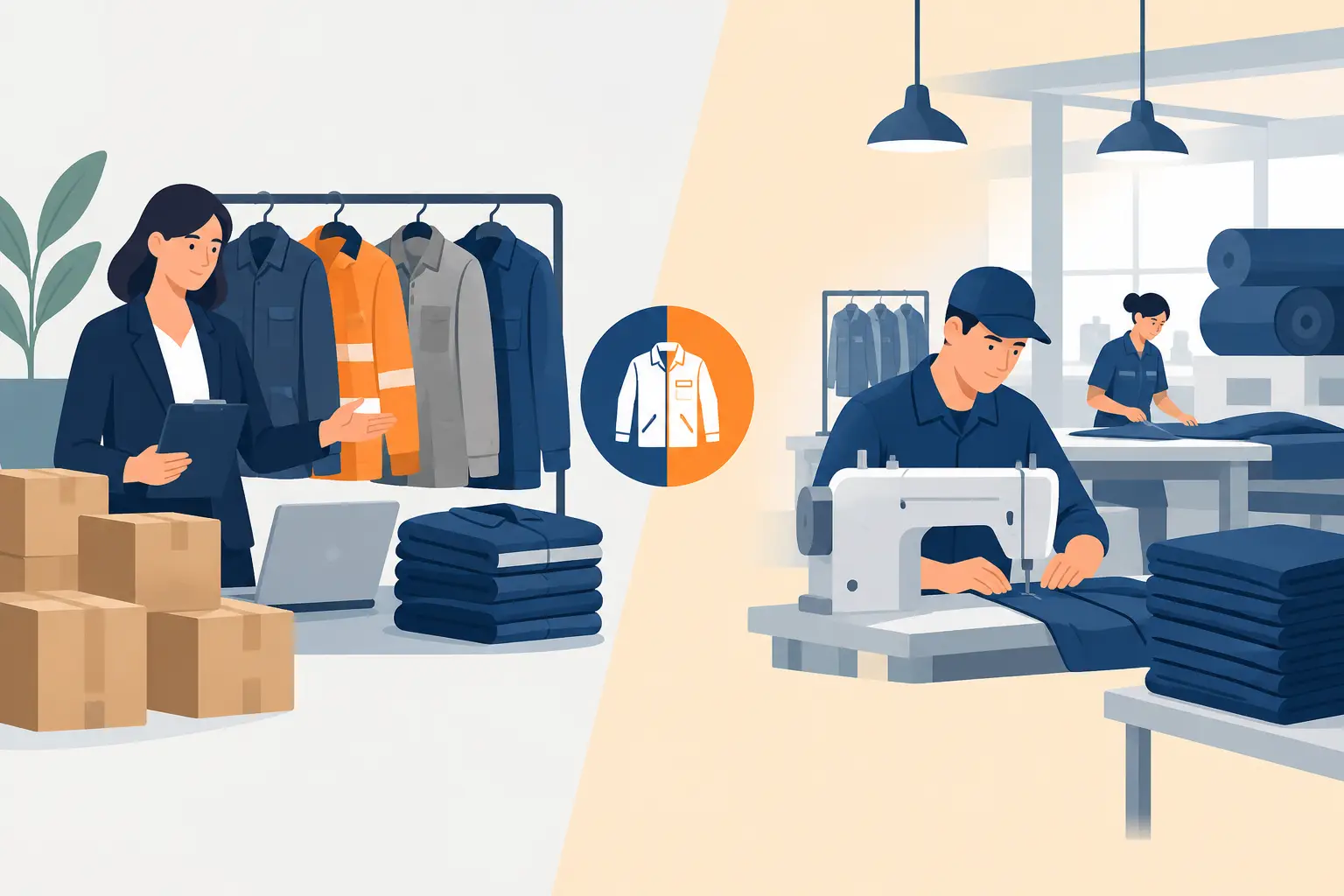
A uniform order can look simple on a purchase request: polos for 120 staff members, safety shirts for a field crew, or branded jackets for a product launch. The real decision starts before fabric, color, or logo placement. When evaluating workwear suppliers versus manufacturers, the partner you select affects control over the finished product, ordering speed, budget certainty, and how consistently your people represent your brand.
For procurement teams, HR leaders, and event coordinators, neither option is automatically better. The right choice depends on whether you need readily available garments, a highly specified uniform program, or a mix of both. The key is knowing what each partner actually controls.
What a Workwear Supplier Does
A workwear supplier typically sources finished garments from established brands or wholesale inventories, then sells them to businesses. Many suppliers also coordinate decoration, such as embroidery, screen printing, or heat transfer, through their own facility or a third party.
This model works well when the priority is speed and familiar, off-the-shelf styles. If your team needs standard cotton tees, high-visibility vests, work pants, or basic polos in commonly stocked colors and sizes, a supplier can often provide practical options without the development process of a custom garment.
A supplier is also useful when your order is small, your requirements are straightforward, or you need to replenish uniforms one piece at a time. For example, a new employee may need two matching polos added to an existing program. Ordering from a stocked range can be more efficient than opening a new production run.
The trade-off is that your choices are limited by what is already available. A stock polo may be close to your corporate color without being exact. Fabric weights, collar construction, pocket locations, reflective trim, zipper style, and size range may not fully match your specification. Stock can also change. A style that worked for this year’s intake may be discontinued or unavailable in a key size before the next order.
What a Workwear Manufacturer Controls
A manufacturer produces garments rather than only sourcing them. That changes the conversation from “Which catalog item should we decorate?” to “What should this garment be made to do?”
With a manufacturing partner, organizations can define details that directly affect comfort, performance, and brand presentation. This may include fabric composition and weight, custom-dyed colors, panel layouts, contrast piping, reinforced seams, sleeve lengths, pockets, labels, zipper pulls, size grading, and packaging. Decoration can be planned as part of the product rather than added after the garment has already been made.
For a company managing a large, recurring uniform program, that level of control protects consistency. A retail team may need a polished polo that carries an exact brand color across multiple branches. A logistics crew may need breathable long-sleeve shirts with reflective elements. A construction or industrial team may require garments selected for a specific work environment and compliance requirement. In these cases, the garment itself is part of the operational standard.
Manufacturing generally requires more planning, especially for custom styles and larger minimum quantities. Samples, artwork approval, fabric selection, and production scheduling all take time. It is not the best route for every rush order. But when the order is substantial or repeatable, building the specification correctly at the start can reduce costly substitutions and rework later.
Workwear Suppliers Versus Manufacturers: The Practical Differences
The most useful comparison is not about labels. It is about accountability from specification to delivery.
Product choice and customization
Suppliers offer a defined assortment. You choose from available garments, colors, and size charts, then apply your branding. Manufacturers can create or adjust the garment itself. If your requirement is a standard black polo with a left-chest logo, a supplier may be all you need. If you need a navy polo matched to a brand standard, with contrast collar tipping, a custom neck label, and embroidery positioned to avoid a chest pocket, manufacturing capability matters.
Customization is not only visual. A thoughtful uniform program considers how employees move, work, and wear the garments over time. The right fabric for an air-conditioned showroom is not necessarily the right fabric for an outdoor road crew.
Lead time and urgency
Stocked goods often provide the faster starting point because the base garment already exists. However, decoration capacity, stock availability, and size distribution still need to be confirmed. A supplier cannot deliver a color or size that is not in inventory.
Custom manufacturing needs a longer runway, but it can offer stronger planning certainty for scheduled rollouts, annual events, and multi-location deployments. The practical approach is to separate urgent replenishment needs from planned uniform cycles. Use stocked items when time is the main constraint, and schedule custom production early when the specification is central to the project.
Quality control
Quality is more than whether a logo looks sharp on delivery day. It includes color consistency, stitch density, print adhesion, sizing accuracy, fabric feel, seam durability, and whether every carton contains the agreed mix of sizes and styles.
A supplier may deliver excellent quality when it represents dependable brands and manages decoration carefully. A manufacturer has an added advantage when control is needed across the full process, from fabric and cutting through decoration and final inspection. That is especially valuable for large orders where small variations become highly visible across hundreds of employees.
Ask both types of partners how they approve samples, inspect finished goods, handle defects, and verify artwork placement. Clear answers are more valuable than broad claims about premium quality.
Pricing and total cost
Catalog garments can appear less expensive because there are no development costs and the supplier is buying established products at scale. That may be the right commercial decision for a basic program.
Yet the lowest unit price is not always the lowest total cost. A cheaper shirt that fades quickly, fits poorly, or must be replaced after a short period creates extra purchasing work and weakens team presentation. Custom manufacturing can be more cost-effective when it produces a durable, repeatable item at volume, particularly if it combines garment production, decoration, labels, and packaging in one managed order.
Compare quotes on the same basis: garment specification, decoration method, number of print locations, size range, packaging, lead time, delivery terms, and expected reorder process. Without that detail, two prices are rarely comparable.
Questions to Ask Before You Choose
Start with the role of the workwear. Is it primarily promotional apparel, everyday staff uniform, protective work clothing, event merchandise, or a premium corporate gift? The answer determines how much emphasis belongs on speed, customization, technical performance, and long-term availability.
Then ask whether the garment needs to be identical every time. If a national rollout, franchise network, school identity, or client-facing team depends on precise brand consistency, document the approved fabric, color reference, logo size, placement, and finishing details. A manufacturer is often better positioned to work from that specification.
You should also ask how orders will be managed after the first delivery. Will departments place small top-up orders? Will seasonal staff need additional sizes? Are new locations opening? A supplier-led catalog program can make replenishment easier, while a manufacturer-led program may require planned reorder quantities. Some organizations use a hybrid approach: custom-manufactured core uniforms for consistency, supported by stocked workwear for urgent replacements.
Finally, assess communication. A capable partner should ask about use conditions, artwork files, size breakdowns, approval steps, and delivery dates before making promises. If a supplier or manufacturer skips these details, the risk moves to your team.
Choose the Partner That Owns the Outcome
The best workwear partner is not simply the one with the biggest catalog or the lowest quote. It is the one whose production model fits your order and who can take responsibility for the result.
For straightforward, fast-turnaround needs, a supplier can provide a practical route to branded workwear. For distinctive uniforms, larger volumes, and programs where color, construction, and repeatability matter, a manufacturer gives you more control over the finished identity. Green Cotton supports both sides of that decision through garment sourcing, custom production, and in-house decoration, so teams can build an order around their real requirements rather than force their requirements into a single option.
Treat your next uniform brief as more than a request for shirts. Define what your people need to wear, what your brand needs to communicate, and what must stay consistent when the next order arrives. That clarity gives any capable production partner the direction to deliver workwear your team can rely on.